Architecting Scalable Medical Imaging: Modernizing Multi-Hospital PACS Infrastructure with Hybrid Cloud Solutions on Amazon Web Services

Modern healthcare networks face an unprecedented deluge of digital information, driven largely by the exponential expansion of medical imaging departments. As multi-hospital chains grow through ongoing mergers and acquisitions, their underlying technological infrastructure often struggles to keep pace. Picture Archiving and Communication Systems (PACS), which have historically relied on localized, siloed hardware setups, are reaching critical breaking points. Each computed tomography (CT) scan generates between 300 and 2,000 DICOM images, magnetic resonance imaging (MRI) procedures yield 500 to 3,000 slices, and digital mammography produces up to a dozen high-resolution files. Multi-facility hospital networks collectively generate millions of these studies annually, accumulating 50 to 200 terabytes of fresh imaging data every year. With regulatory mandates requiring this data to be retained safely for seven to ten years, healthcare IT architects are forced to rethink legacy storage strategies entirely.
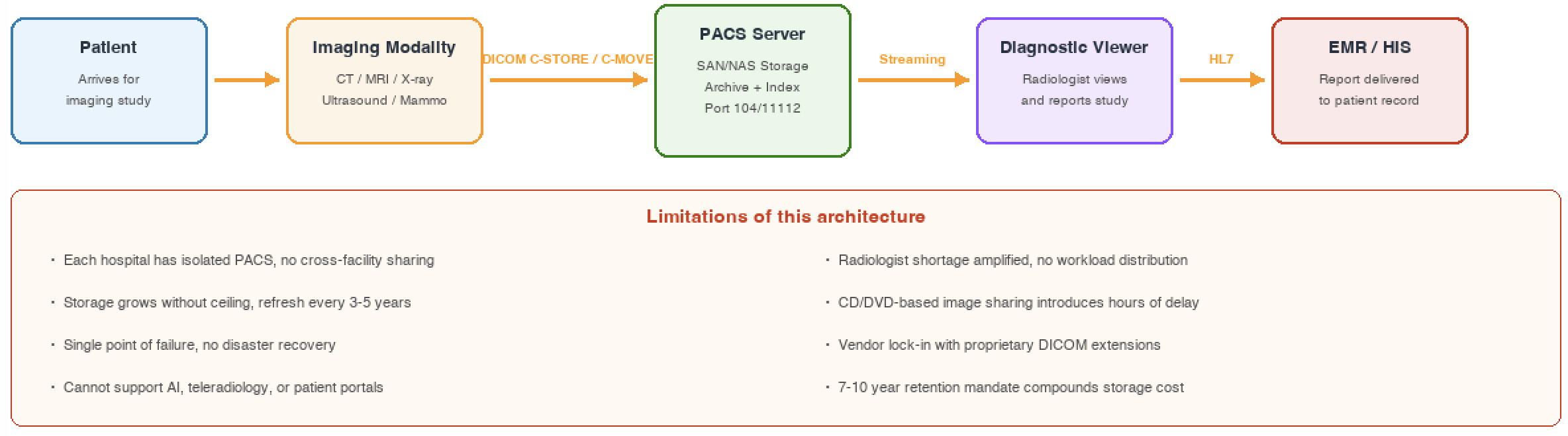
The traditional approach to medical imaging management—deploying independent on-premises PACS servers paired with localized Storage Area Networks (SAN) or Network Attached Storage (NAS) at each hospital facility—worked well enough during an era of modest data volumes. However, as enterprise networks expand, the constraints of this fragmented model become starkly apparent. Operating isolated silos creates data islands, making it cumbersome for clinicians at one facility to access historical imaging records captured at another. Furthermore, the total cost of ownership spirals upward due to recurring hardware refresh cycles, physical data center footprint limitations, and the manual administrative overhead required to maintain disparate systems across various regional campuses.
To understand the operational friction this creates, one must examine the standard clinical workflow. The process typically begins when a clinician orders an imaging study through a Radiology Information System (RIS). The system populates a modality worklist, allowing a technologist to select the patient entry and execute the scan. The imaging scanner then transmits Digital Imaging and Communications in Medicine (DICOM) objects directly to the local PACS server using the C-STORE network protocol over the hospital’s Local Area Network (LAN). A standard DICOM object encapsulates both rich pixel data and complex administrative metadata. Upon ingestion, the local PACS server indexes the metadata, archives the images to the local SAN or NAS storage tier, and populates the radiologist’s worklist. The radiologist reviews the images alongside the patient’s medical history, formulates a formal report, and transmits those findings back to the Electronic Medical Record (EMR) via Health Level Seven (HL7) messaging.

While this localized loop functions smoothly within the boundaries of a single hospital campus, it breaks down completely at the enterprise scale. The core communication protocol underpinning this workflow, DICOM DIMSE (DICOM Message Service Element)—which includes services like C-STORE for sending, C-FIND for querying, C-MOVE for retrieving, and C-ECHO for verifying connectivity—was originally architected exclusively for high-speed local area networks. Extending these native DICOM services across wide-area enterprise networks introduces severe latency, bottlenecking cross-facility collaboration and teleradiology reading sessions. Meanwhile, DICOMweb, a set of modern RESTful services designed to make medical imaging accessible via standard web toolsets, has begun paving the way for cloud integration, but legacy infrastructure often lacks the native capabilities to leverage these standards at scale.
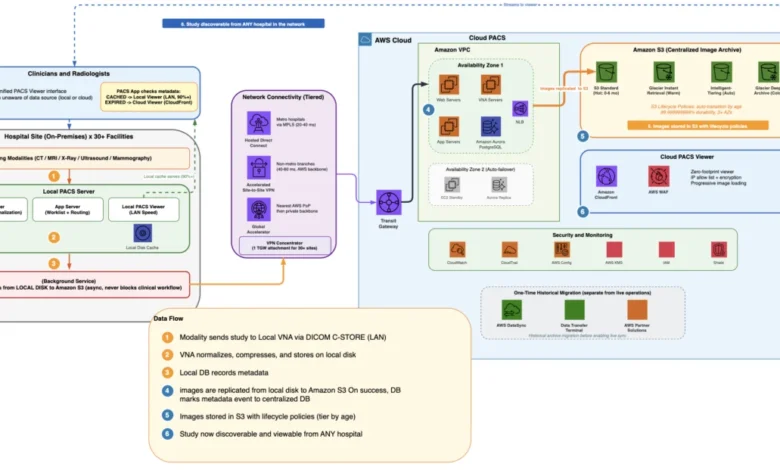
To resolve these architectural limitations, healthcare organizations are increasingly turning toward a hybrid cloud framework built on Amazon Web Services (AWS). Rather than attempting a high-risk, all-at-once migration of active clinical workloads to the cloud, a hybrid hub-and-spoke architecture provides a balanced, pragmatic pathway. In this model, individual hospital facilities act as operational spokes, maintaining localized PACS caching instances that guarantee instantaneous, LAN-speed image retrieval for day-to-day clinical care. These local instances connect securely via AWS Direct Connect or dedicated AWS Site-to-Site VPN tunnels to a centralized cloud archive hub operating within the AWS Cloud.
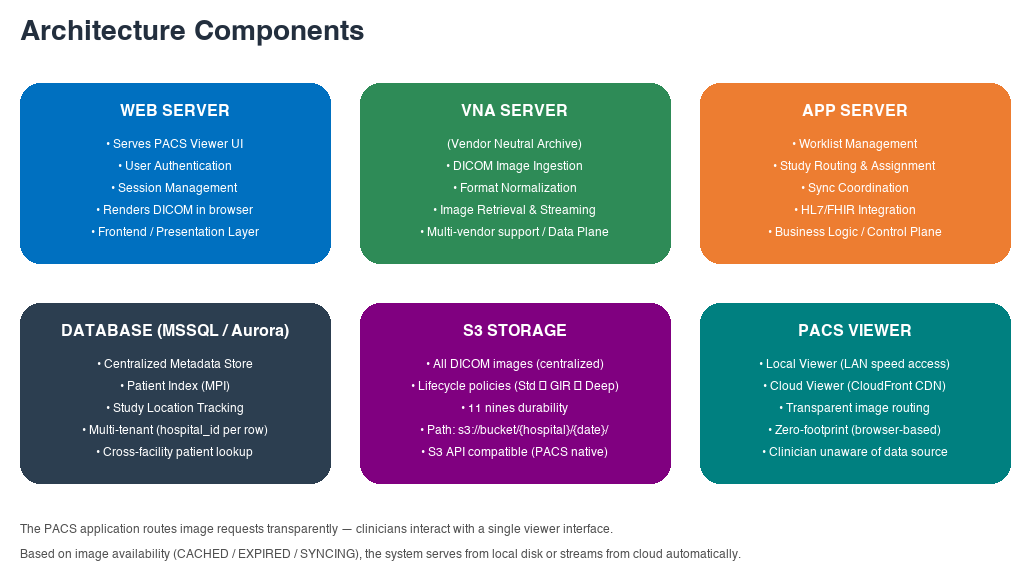
Every robust PACS architecture relies on six fundamental functional components, regardless of whether it is deployed on bare-metal servers or cloud infrastructure. The web server layer manages the PACS viewer user interface, user authentication, and secure session management, rendering DICOM files directly in standard web browsers with zero client-side installation requirements. The Vendor-Neutral Archive (VNA) server handles incoming DICOM ingestion from imaging modalities, normalizes varying vendor-specific data encodings, compresses the files, and directs them to storage. The application server coordinates complex worklist management, study routing logic, and system synchronization, integrating seamlessly with hospital information systems via HL7 version 2 or FHIR REST application programming interfaces.
Supporting these operational layers is a relational database management system—such as Amazon Aurora PostgreSQL—which stores the Master Patient Index (MPI), study location pointers, and synchronization states, enabling rapid cross-facility patient lookups. Object storage services replace traditional physical SAN and NAS arrays with infinitely scalable, pay-per-use repositories. Finally, advanced PACS viewers provide dual-access capabilities, intelligently routing clinician requests between local cache and cloud storage without end-users ever needing to know where the physical byte stream originates.
By deploying a consistent PACS software vendor stack across all hospital spokes and mirroring it within the cloud hub, health systems establish a unified enterprise imaging record. When a radiologist at one facility needs to query and open a study acquired at an entirely different hospital within the network, the shared metadata database makes that discovery instantaneous. In the background, newly generated studies are asynchronously replicated to Amazon Simple Storage Service (Amazon S3) over private enterprise network connections, ensuring that active clinical workflows are never interrupted or delayed by cloud synchronization processes.
Within the AWS cloud environment, the centralized PACS infrastructure runs across multiple Availability Zones in a designated AWS Region, ensuring high availability and fault tolerance. Compute operations are handled by Amazon Elastic Compute Cloud (Amazon EC2) instances residing behind resilient Network Load Balancers equipped with automatic traffic failover. If a local hospital server experiences a hardware failure, incoming requests are automatically rerouted to the cloud environment, where all recent data has already been securely synchronized. Conversely, if wide-area network connectivity to the cloud is temporarily disrupted, the local hospital cache continues serving recent patient studies without interruption, safeguarding continuity of care.
Data security and patient privacy remain paramount when handling sensitive medical imaging records, which contain protected health information (PHI) embedded within DICOM headers. Under the AWS shared responsibility model, AWS secures the underlying physical cloud infrastructure, while healthcare organizations retain responsibility for configuring services, managing access permissions, and establishing robust audit controls. The architecture leverages AWS Key Management Service (AWS KMS) for encryption key management with automated key rotation, enforcing strict encryption of data both at rest and in transit across every layer of the network. Comprehensive audit logging is maintained through AWS CloudTrail and Amazon S3 access logs, while AWS Identity and Access Management (IAM) enforces the principle of least privilege through granular, role-based access controls. Continuous infrastructure monitoring via AWS Config ensures ongoing compliance with stringent regulatory frameworks like HIPAA. Furthermore, deploying workloads within specific regional AWS locations guarantees that patient data remains strictly within designated national borders to satisfy sovereign data residency requirements.
One of the most compelling financial and operational advantages of migrating PACS storage to AWS is the ability to align infrastructure costs directly with actual data access patterns through Amazon S3 storage tiers. Traditional on-premises storage models force hospitals to house all medical imaging data on a single, expensive high-performance hardware tier, regardless of how frequently those files are actually accessed. In contrast, medical imaging exhibits a highly predictable decline in access frequency over time. Studies are accessed heavily during their first six to twelve months while active reporting, patient consultations, and follow-up examinations take place. After this initial window, access drops off sharply, with historical files only occasionally retrieved for long-term comparative reads.
To capitalize on this lifecycle curve, healthcare IT architects can configure Amazon S3 lifecycle policies to automatically transition data across specialized storage classes. For active studies in their first year, S3 Standard provides millisecond access speeds and high throughput, matching the exact performance expectations of traditional local SAN hardware without the massive upfront capital expenditure. For warm data—studies older than twelve months that are occasionally needed for longitudinal comparisons—Amazon S3 Glacier Instant Retrieval delivers the same millisecond retrieval speeds as S3 Standard while offering substantially lower storage costs, offset by nominal retrieval fees. For unstructured research datasets with highly unpredictable access patterns, Amazon S3 Intelligent-Tiering automatically moves objects between frequent and infrequent access tiers without operational overhead or retrieval charges. Finally, for long-term retention archives mandated by legal compliance to be stored for up to a decade, Amazon S3 Glacier Deep Archive provides secure, highly durable storage at a minimal cost, with retrieval times ranging from 12 to 48 hours.
When evaluating modernization strategies, healthcare executives must decide whether to pursue a fully cloud-native PACS deployment or a hybrid model. A cloud-only architecture is an ideal fit for organizations seeking to entirely eliminate on-premises hardware footprints, bypass expensive hardware refresh cycles, and fully centralize IT operations across all geographical locations. On the other hand, a hybrid model is recommended for hospital networks that operate across regions with inconsistent broadband infrastructure, or for systems bound by strict internal governance policies that mandate localized survivability. Both deployment paths utilize AWS as the foundational, highly durable long-term archive, differing only in where the active working data set resides day-to-day.
Ultimately, transitioning medical imaging infrastructure to a hybrid cloud model on AWS empowers healthcare networks to overcome the persistent limitations of legacy on-premises architectures. By neutralizing storage cost inflation, dismantling facility data silos, eliminating radiologist workflow bottlenecks, and accommodating unbounded archive growth, health systems can future-proof their clinical imaging operations. Healthcare IT leaders are advised to initiate their modernization journey by conducting a comprehensive inventory of existing imaging devices and performing a granular analysis of historical data access patterns, translating strategic architectural concepts into a concrete, data-driven migration roadmap.
Related posts: